The United Kingdom has long been a cradle for architectural innovation, producing some of the most influential architects in history.
Ranking third globally in the number of prominent architects behind Italy and Germany, Britain’s architectural legacy is rich and diverse.
From historic landmarks to cutting-edge modern designs, British architects have shaped skylines around the world.
This article highlights the 10 most famous British architects, recognized for their lasting impact on architecture.
These figures have been celebrated not only for their creative vision but also for their cultural significance, with many biographies translated into multiple languages.
Exploring their work offers a glimpse into the evolution of architecture from classical to contemporary styles, showcasing the unique contributions of British talent to the global architectural landscape.
1. John Nash

John Nash stands as a key figure in British architecture, renowned for shaping London’s Georgian and Regency landscapes.
He designed iconic structures like the Royal Pavilion in Brighton, Marble Arch, and Buckingham Palace.
Nash collaborated extensively with developers James Burton and his son Decimus Burton, producing landmarks such as Regent Street, Regent’s Park, and Carlton House Terrace.
His neoclassical and picturesque styles continue to influence urban design, reflecting timeless elegance in Britain’s architectural heritage.
2. Richard Rogers

Richard Rogers was a pioneering British architect known for high-tech modernism, exposing structural elements and service infrastructure.
His iconic projects include the Pompidou Centre in Paris, co-designed with Renzo Piano, featuring colorful external ducts and steel frameworks.
In London, Rogers’ Lloyd’s headquarters showcased modular service towers and external steel, making the building functionally expressive.
He advocated sustainable design, influencing environmental policies. Rogers received the Pritzker Prize in 2007 and was knighted in 1991.
His innovative approach redefined contemporary architecture, blending technology with bold aesthetics.
3. Norman Foster
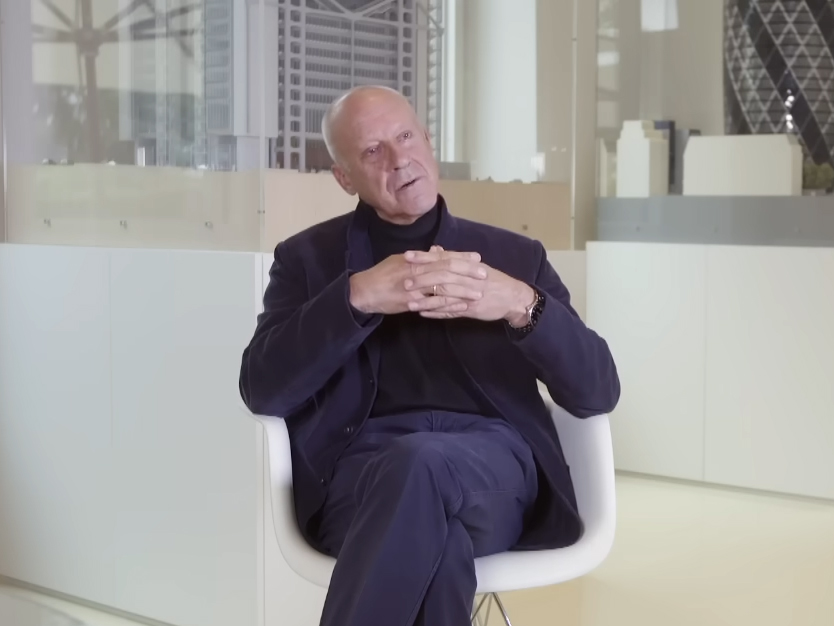
Norman Foster stands as the most famous British architect, with an HPI of 7870. Born in 1935, he revolutionized high-tech modernism with iconic structures like 30 St Mary Axe (The Gherkin), London’s City Hall, and the Millennium Bridge.
His firm, Foster + Partners, is the UK’s largest and operates globally, pioneering sustainable and technically innovative designs.
Foster’s impact extends beyond architecture through the Norman Foster Foundation, promoting interdisciplinary research.
Awarded the Pritzker Prize in 2000, he remains a key figure shaping modern British and international architecture.
4. David Chipperfield

David Chipperfield founded David Chipperfield Architects in 1985, expanding globally with studios in London, Berlin, Milan, and Shanghai.
They specialize in cultural, residential, and commercial projects, blending architectural and interior design. The firm has won over 50 competitions and numerous awards, including the 2018 National Design Award for Interior Design.
Notable projects include The Hepworth Wakefield in the UK, James Simon Gallery in Berlin, and Nobel Center in Stockholm. Chipperfield’s minimalist approach emphasizes context and timelessness, securing his reputation as a leading figure in contemporary British architecture.
5. Zaha Hadid

Zaha Hadid redefined modern architecture with her radical deconstructivist style. Born in Baghdad, she drew inspiration from Iraqi architectural heritage, pioneering parametric design with sweeping curves and fragmented forms.
Her firm, Zaha Hadid Architects, used cutting-edge technology to create iconic projects like the London Aquatics Centre and Guangzhou Opera House.
Awarded the Pritzker Prize in 2004 and multiple Stirling Prizes, Hadid’s visionary work blends urbanism, landscape, and geology, setting new standards for futuristic architecture worldwide.
6. Tom Wright

Tom Wright is celebrated for his landmark design of the Burj Al Arab in Dubai, which redefined luxury hotel architecture with its sail-shaped silhouette.
He pioneered iconic, sculptural forms that combine engineering innovation with striking aesthetics.
Wright’s work emphasizes bold, instantly recognizable structures that elevate city skylines. Aside from the Burj, his projects include the Jumeirah Beach Hotel and Dubai Creek Golf & Yacht Club, showcasing his flair for blending modernity with context-driven design.
His visionary approach continues to influence contemporary British and international architecture.
7. James Stirling

James Stirling expanded modern architecture’s possibilities with experimental, postmodern buildings. He designed the Leicester University Engineering Building, blending Victorian ironwork with modernism.
Stirling’s Florey Building at Oxford features a dynamic spiral staircase showcasing playful design. His collaboration on the Camberwell School Assembly Hall and the colorful Braun Headquarters in Maidenhead reflect his irreverent approach.
Stirling’s No 1 Poultry in London exemplifies his late ornate style. Based in Britain throughout his career, Stirling remains a key figure in British postmodern architecture.
8. Augustus Pugin

Augustus Pugin was a leading figure in the 19th-century Gothic Revival movement. He apprenticed under his father, gaining hands-on experience in Gothic design through detailed drawings and stone carving.
Pugin believed Gothic architecture was the true Christian style, evident in his landmark work on the Palace of Westminster’s interior and the Elizabeth Tower housing Big Ben.
His designs combined medieval craftsmanship with Victorian innovation, influencing church architecture across England, Ireland, and Australia.
Pugin’s lasting impact lies in merging morality with architecture, setting a standard for Gothic Revival aesthetics.
9. David Adjaye

David Adjaye reshapes contemporary British architecture with culturally rich, innovative designs. He combines materiality and light to create powerful spaces, exemplified by the Smithsonian National Museum of African American History and Culture in Washington, D.C.
His London projects, like the Studio Voltaire and the Ark Ada Primary School, showcase social sensitivity and urban integration.
Founder of Adjaye Associates, he emphasizes architecture’s role in community identity and storytelling, making him a leading figure in global and British modern architecture.
10. Laurie Baker

Laurie Baker championed sustainable and cost-effective architecture in the UK and India. He employed eco-friendly materials like brick and local stone, promoting passive cooling and natural ventilation. Baker’s designs emphasized simplicity and functionality, reducing waste and energy consumption.
Notable for integrating traditional craftsmanship with modern needs, his work included residential homes and community buildings.
By focusing on affordability and environmental harmony, he influenced green architecture practices and inspired architects committed to socially responsible design worldwide.
Alicia Richards